CETV Calculator

Final Salary Pension Transfer Calculator

For Defined Benefit Pensions

Schedule a free discovery call with a Pension Transfer Specialist

Published: 15 January 2021 Last updated: 23 August 2026

CETV calculator: estimate your transfer value

Enter the annual pension your scheme has promised you and the age it is due to start, and the calculator returns a realistic high and low CETV estimate based on current industry average multiples. It takes under a minute and you do not need to hand over your email address to see the result.

Quick Answer

A cash equivalent transfer value (CETV) is the lump sum your final salary (defined benefit) pension scheme will pay you in exchange for giving up your guaranteed income for life. Most CETVs currently sit between 18 and 22 times the annual pension you have been promised, with offers across the market generally falling between 15 and 25 times, well below the 30 to 40 times peaks of 2020 and 2021. Our free CETV calculator below gives you a realistic high and low estimate in under a minute. If your transfer value is more than £30,000, FCA rules require you to take advice from a qualified Pension Transfer Specialist before you can transfer.

CETV Calculator

Free CETV Calculator

Estimate the transfer value of your final salary (defined benefit) pension in seconds.

Estimated transfer value range

Your estimate is above £30,000. FCA rules mean you must take advice from a qualified Pension Transfer Specialist before you can transfer. That is exactly what we do.

This is a guide based on industry average multiples, not an offer or financial advice. Your scheme sets its own calculation and your actual CETV may fall outside this range. Request your exact figure from your scheme administrator (free once every 12 months).

Your figures never leave this page. Nothing is stored, sent or tracked.

Assumptions

This calculator estimates your CETV using industry average transfer value multiples: a typical band of 18 to 22 times your promised annual pension, adjusted modestly by your pension start age, within the current market span of 15 to 25 times. Sources: the XPS Transfer Value Index and published industry analyses of 2022 to 2026 transfer values; multiples last refreshed August 2026. It does not use your scheme’s own calculation basis, which is set by the trustees and rarely published. Your actual CETV can only come from your scheme administrator, and it may fall outside the range shown.

Projections are estimates, not guarantees. Past performance is not a reliable indicator of future results. This tool is a guide only. It is not financial advice and not a recommendation to transfer.

On this page

    What is a cash equivalent transfer value (CETV)?

    A cash equivalent transfer value is the cash lump sum your defined benefit scheme offers you in exchange for giving up everything the scheme has promised: your guaranteed income for life, the inflation increases attached to it, and the survivor's pension for your spouse or dependants.

    The FCA calls these promises safeguarded benefits, and that word is deliberate. Once you transfer, they are gone. You cannot buy them back.

    Your CETV is not a savings pot with your name on it. It is the scheme actuary's price for releasing the scheme from its promise to you. You have a statutory right to one free CETV every 12 months. Some schemes print an up-to-date figure on your annual statement; if yours does not, request it from your scheme administrator.

    How is a CETV calculated?

    Your scheme's actuary works out how much money the scheme would need today to pay your promised pension for the rest of your life, using assumptions about gilt yields, inflation and life expectancy. The result is usually expressed as a multiple of your annual pension. A £10,000-a-year pension at a multiple of 25 produces a CETV of £250,000.

    Every scheme runs its own calculation, set by the trustees and rarely published. Six factors do most of the work:

    Your scheme's rules

    Trustees set the calculation basis and can change it at their discretion. Two members with identical pensions in different schemes can receive very different offers.

    Your age and how close you are to retirement

    Transfer values rise as you approach retirement, because the scheme has less time to grow its assets before the payments start. Research by LCP and Royal London confirmed this pattern across UK schemes.

    Inflation, and whether your scheme uses CPI or RPI

    Final salary pensions must rise with prices by law. A scheme that increases pensions by RPI is promising more than one using CPI, and its transfer values reflect that.

    Life expectancy

    The scheme expects to pay you until you die, so the longer its actuary assumes you will live, the bigger the promise being priced. Schemes price on an average-member basis, so your personal health rarely affects the figure.

    Gilt yields and market conditions

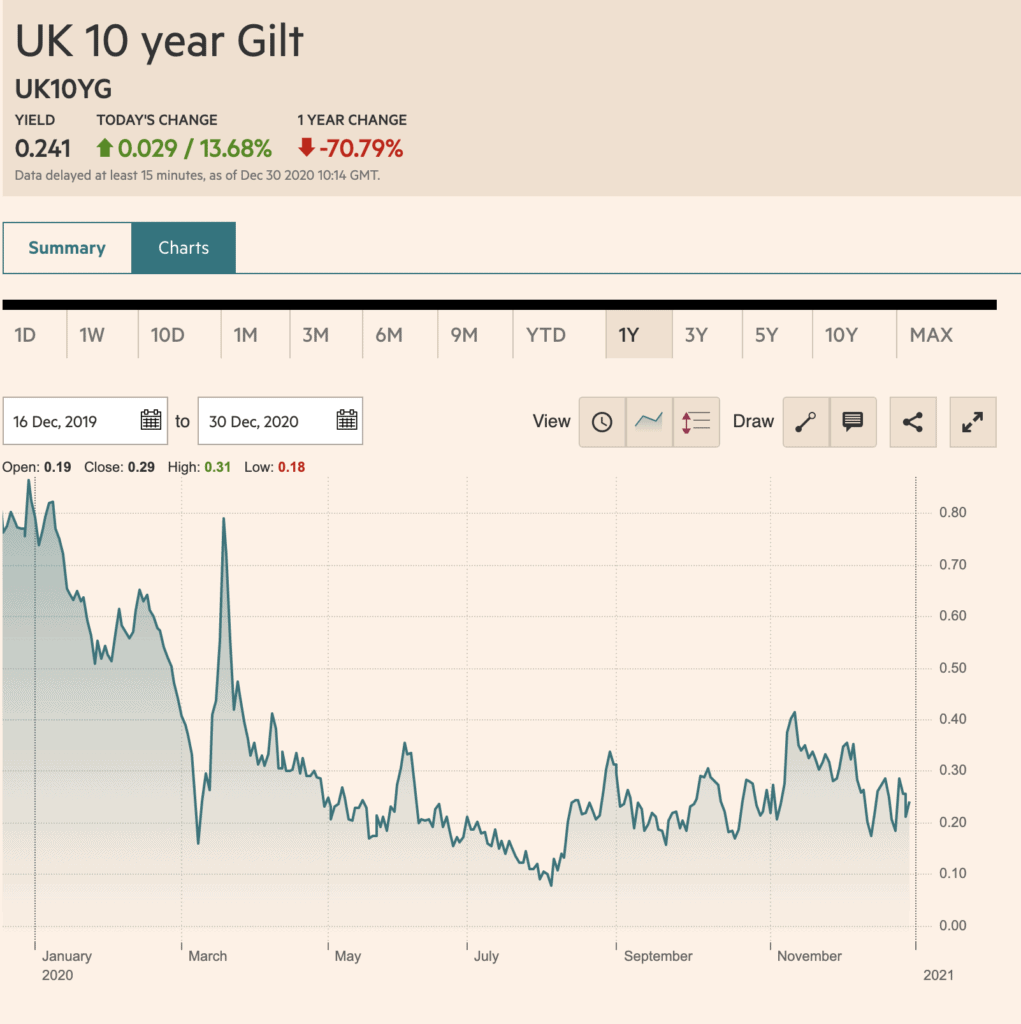
    This is the biggest driver of the last few years since most Defined Benefit Pension Schemes 'de-risked' and invested in historically 'low-risk' Gilts to ensure long-term scheme sustainability.

    When gilt yields rise, the scheme needs less money today to fund your future pension, so CETVs fall. That is exactly what happened from late 2022 onwards.

    Scheme funding

    If the scheme is underfunded, trustees can reduce transfer values to protect the members who stay. A generous-looking multiple from a well-funded scheme and a reduced offer from a struggling one are telling you different things.

    What is a good CETV?

    A good CETV is one that funds your retirement plan more reliably than the guaranteed pension you would be giving up, and for most people no multiple clears that bar. The size of the number matters far less than what it has to do for you.

    That said, multiples are the fastest way to judge whether an offer is generous by market standards:

    Multiple of annual pension

        What it means in 2026

    Below 18×

    Below the typical range. Common where a scheme applies a funding reduction, and in periods of higher gilt yields.

    18× to 22×

    The typical range in current conditions. Most offers we see now land here.

    22× to 25×

    The top of the current market range. Usually reflects a strong, well-funded scheme with generous increases.

    Above 25×

    Exceptional in current conditions. Multiples of 30 to 40 times were common at the 2020 to 2021 peak but are now rare.

    The same £10,000-a-year pension is worth £200,000 at 20 times and £400,000 at 40 times. Nothing about your pension changed between those two numbers. The market conditions and the scheme's assumptions did, which is why judging a CETV by its size alone is a mistake.

    A high CETV does not automatically make transferring right for you. A guaranteed, inflation-linked income for life is extremely expensive to replace, and most people who run the numbers properly find the scheme's promise is worth more than the cash.

    Why is my transfer value higher than my fund value?

    Because a defined benefit pension has no fund value. There is no personal pot being invested on your behalf, so there is nothing for the CETV to exceed. What your scheme has is a promise to pay you an income, and the CETV is the actuary's price for cancelling that promise.

    If you are comparing your CETV against a figure on an old statement, you are probably looking at your accrued annual pension, not a fund. Multiply that annual figure by the multiples above and the CETV will start to make sense. If your CETV looks lower than you expected, check whether your scheme is applying a funding reduction, and remember that values across the market have fallen significantly since 2021.

    Final salary pension calculator: what your pension is worth if you stay

    If you stay in your scheme, your pension is usually calculated as: accrual rate × years of service × final or career average salary. No investment risk, no drawdown decisions, and it rises with inflation once in payment.

    A worked example: a 1/60th scheme, 20 years of service and a £50,000 final salary produces a pension of £16,667 a year, payable for life from your scheme's retirement age, with a survivor's pension on top, typically half, for your spouse.

    Before you compare that with any lump sum, price what it would cost to buy the same guaranteed, inflation-linked income from an insurer. It is nearly always far more than people expect, and that gap is the real measure of what you would be giving up.

    Are transfer values rising or falling in 2026?

    According to the XPS Transfer Value Index, Average Transfer values have largely fallen in 2026. Average values were £141,321 on 01 Jan 2026; they showed signs of recovery, rising to £146,188 at the end of February, but unrest in the Middle East and Iran, and its wider economic impacts, saw average transfer values fall to £137,970 in July 2026.

    At their peak in December 2021, average transfer values reached £270,840, but in recent years transfer values have plummeted. Sept 2025 saw the lowest average transfer values, £133,648, since the XPS Transfer Value Index Tracker launched in 2018. 2026 transfer values are only slightly above the 8-year low.

    We track why this happened and what it means for anyone holding a deferred final salary pension in a dedicated article: DB Pension Transfer Values in 2026: Why They Fell and Will They Recover? (https://www.2020financial.co.uk/db-pension-transfer-values-2025-update/).

    How long is my CETV valid?

    Your CETV is guaranteed for three months from the date it is calculated. Decide within that window or the offer expires and you will need to request a new one, which may be higher or lower, and only one CETV in any 12-month period is free.

    Three months sounds like plenty. In practice, it is tighter than people think because regulated transfer advice has to happen within it. Simon Garber, DipPFS, Qualified Pension Transfer Specialist and Managing Director of 2020 Financial, puts realistic numbers on it:

    "In terms of getting the advice you need, I would say 3 to 5 weeks is a realistic timescale, if you have your CETV available and are able to respond to our information requests quickly. But we have spoken to clients who have engaged financial advisors whose timescales are 3 to 6 months."

    The pattern that causes trouble is procrastination. People come to us with two or three weeks left before their CETV expires, and it is simply not possible to request and receive everything we need from the pension trustees in that time. If you are going to take advice, start when the CETV arrives, not when it is about to expire.

    Full detail on every stage: Defined Benefit Pension Transfer Timescales (https://www.2020financial.co.uk/defined-benefit-pension-transfer-timescales/).

    Do I need advice to transfer? The £30,000 rule

    Yes, if your transfer value is £30,000 or more. It is a legal requirement, set by the FCA, that you take advice from a firm with pension transfer permissions before transferring safeguarded benefits worth more than £30,000. The advice must come from, or be checked by, a qualified Pension Transfer Specialist.

    That advice is not a signature on a form. The adviser must produce an Appropriate Pension Transfer Analysis (APTA, which replaced the old TVAS reports in 2018), including a Transfer Value Comparator showing what your CETV would need to earn to match the benefits you are giving up, and a personal recommendation to transfer or to stay.

    Two consumer protections worth knowing about:

    • Contingent charging has been banned since October 2020. You pay the same fee whether the recommendation is to transfer or not, so the advice has no financial reason to lean either way.
    • Most major pension providers now refuse to receive a DB transfer without a positive recommendation. If a specialist concludes a transfer is not in your interests, you will struggle to do it anyway.

    If your CETV is under £30,000, you can transfer without advice, but the benefits you are giving up are the same kind, and the mistakes are just as permanent. MoneyHelper, the government-backed guidance service, is a sensible free starting point if you are below the threshold.

    What are the tax implications of a final salary pension transfer?

    The transfer itself is tax-free. Moving a CETV into a UK registered pension scheme does not trigger a tax charge. The tax consequences arrive later, when you take the money out, and they are worth understanding before you transfer rather than after:

    • Tax-free cash. You can normally take 25% of the transferred pot tax-free, capped by the Lump Sum Allowance of £268,275 across all your pensions. On a £400,000 CETV, that is £100,000; on pots above £1,073,100, the cap bites regardless of size.
    • Income tax on the rest. Withdrawals beyond your tax-free cash are taxed as income at your marginal rate. Large, badly timed withdrawals can push you into the 40% or 45% bands, and around £100,000 of income the personal allowance taper creates a 60% effective rate.
    • The Money Purchase Annual Allowance. The first time you take flexible income from the transferred pot, your annual allowance for future pension contributions drops from £60,000 to £10,000, permanently. Taking only tax-free cash does not trigger it.
    • Inheritance tax from April 2027. Unused defined contribution pension funds will count towards your estate for IHT. The old argument that a transferred pension sits outside your estate is no longer true, which weakens one of the most common reasons people gave for transferring. Full analysis: What Happens to Your Final Salary Pension When You Die?.
    • Overseas transfers. Moving a CETV to a qualifying overseas scheme (QROPS) has its own allowance, and transfers above it are taxed at a flat 25%. Specialist territory; take advice.

    What do you give up if you transfer?

    Everything the scheme guarantees. In exchange for the lump sum you permanently give up:

    • A guaranteed income for every year of your life, however long you live.
    • Inflation protection, because that income rises with prices by law.
    • A survivor's pension for your spouse or dependants, usually half your pension.
    • Pension Protection Fund cover, the statutory safety net that stands behind DB schemes if the employer fails.
    • In some schemes, a protected early retirement age or guaranteed terms that no personal pension can replicate.

    In their place, you take on investment risk, longevity risk and ongoing costs, and the responsibility for making a pot last 30 years or more. Research by Zurich found that 41% of people in drawdown without financial advice were on course to run out of money in retirement. That is not a marginal risk. It is close to a coin flip.

    The FCA's starting assumption is that a DB transfer will not be suitable for most people, and the receiving end of the industry agrees: most platforms will not accept a transfer without a positive recommendation. When the regulator and the product providers both default to "no," the burden of proof rests firmly with the transfer case. Warning signs to check before you go anywhere near a transfer: Defined Benefit Transfer Warning Flags.

    Should I transfer my final salary pension?

    For most people, no. Final salary benefits cannot be replaced like-for-like, transfer values are low by recent standards, and the FCA's starting assumption of unsuitability is usually right. A transfer only earns serious consideration in specific circumstances:

    • You are single with no dependants, so the survivor's pension you would give up has no one to protect.
    • Your essential spending is already covered by other secure income, and this pension is genuinely surplus.
    • You have a shortened life expectancy or health issues that affect the value of a lifetime income.
    • You have real investment experience and are comfortable carrying the risk for decades, not just this year.

    Even then, the right answer often keeps the pension where it is. This year we have spoken to several people in their 40s and early 50s whose only reason for wanting a transfer was fear that a 50% survivor's pension would leave their spouse short. We solved it with an appropriate life insurance policy, at a fraction of the long-term cost and risk of a transfer, and they kept every guarantee their scheme provides.

    One more number for the self-management case. Research published in 2019 by the International Longevity Centre UK, supported by Royal London, found that people who took financial advice were on average £47,706 better off over the following decade than similar people who did not, even after fees. Deciding alone is not the money saver it appears to be.

    Our full guide covers every factor in depth: The Definitive Guide to Final Salary Pension Transfer.

    Can I calculate an NHS, teachers or civil service CETV?

    Not for transfer purposes. The NHS, teachers, civil service, armed forces, police and firefighter pensions are unfunded public-sector schemes, and transfers from them to defined-contribution pensions have been banned since April 2015. A CETV calculator cannot help you, because no transfer is available at any price.

    The exception is the Local Government Pension Scheme (LGPS), which is funded, so transfers out are legally possible, subject to the same £30,000 advice requirement and the same heavy presumption against.

    Public sector schemes still produce cash-equivalent values for divorce proceedings. That is a different calculation for a different purpose. We are unable to offer advice on pensions in divorce; please speak to your solicitor.

    Speak to a Pension Transfer Specialist

    A CETV estimate tells you what the scheme might offer. It cannot tell you whether taking it is a good idea. That takes a full analysis of your income needs, your other assets, your health and your family's position, which is exactly what the regulated advice process is for.

    Book a free 20-minute call with our Qualified Pension Transfer Specialist to find out your next steps.

    Frequently Asked Questions

    How do I get my actual CETV?
    Is the calculator's estimate guaranteed?
    What is a typical CETV multiple in 2026?
    How long does a final salary pension transfer take?
    FCA Advice on Defined Benefit Pension Transfers
    Can I transfer my final salary pension myself?
    How much does pension transfer advice cost?
    Why is my CETV lower than it was two years ago?
    Can I get a CETV for divorce?
    What happens to my final salary pension when I die?
    Can I cash in my final salary pension at 55?
    Does requesting a CETV commit me to anything?
    Is a CETV taxable when I transfer it?
    Simon Garber

    Simon Garber

    Simon Garber, DIP PFS, runs 2020 Financial Ltd. He's an Independent Financial Adviser and Pension Transfer Specialist with over 20 years of experience. He's FCA registered, a member of the Personal Finance Society and holds the coveted Gold Standard for Defined Benefit Pension Transfer Advice.

    He is the Managing Director of 2020 Financial Ltd, Financial Advisors specialising in Retirement Planning & Wealth Management, based in Southampton, Hampshire.

    Speak to a Pension Transfer Specialist

    Filled in the calculator and still not sure whether a final salary pension transfer is the right choice for you? Arrange a free consultation with a member of our team. We’d love to chat.

    For expert guidance

    Check out our blog

    These are some of our most popular posts.  Click below or head over to our blog to see other helpful articles on Final Salary Pensions and retirement.


    What happens to your Final Salary Pension when you die - header

    What Happens to your Final Salary Pension when you die?

    Simon Garber Penson Transfer Specialist answers Can Final Salary Pensions be cashed in? 2020 Final Salary Guide

    11 Factors to Consider before you transfer your final salary pension

    Graph of Defined benefit transfer value Index 2020 - transfer values reach highest level July 2020

    Why are Final Salary Pension Transfer Values so High?

    How much does a financial adviser cost?

    How much does a Final Salary Pension Transfer Cost?

    Can I transfer my defined benefit pension_2020 financial_defined benefit transfer suitability report

    Can I Transfer my Final Salary Pension?

    Lifetime allowance and final salary pensions

    Lifetime Allowance and Final Salary Pensions

    Defined Benefit Pension Transfers

    Here are just some of the company pension schemes we can advise on

    As an independent Qualified Pension Transfer Expert, we can offer advice on all private sector Defined Benefit Pension Schemes.